
We recently shared on social media how restorative justice may be expressed through creative arts, and one of the resources mentioned was ‘Reimagining Justice,’ a virtual restorative justice art show hosted in 2020 by the National Center on Restorative Justice at Vermont Law School.
Read moreWhat’s behind a name?
This first piece explores why we are called “The Mint House”. If this interests you, read on. The building in which the Mint House was launched in 2015 – and from which we operate when we need a physical space – is alleged to have been the temporary location for the Royal Mint of King Charles I during the English Civil War in the 1640s.
Read moreHelping children explore and express their emotions: some summer book recommendations
It’s the season of summer book recommendations. In that spirit, we thought it would be good to share some books for younger children that contributors to our recent restorative parenting podcast said they’d found especially helpful in helping children develop emotional vocabulary and opening up conversations about emotions.
Read moreJuliet, her Romeo and Restorative Justice
Shakespeare’s Romeo and Juliet begins like a comedy, with the first half of the play filled by light-hearted banter, but it ends as a tragedy with the waste of two young lives. Viewed through the lens of the modern ‘restorative justice’ movement, the situation cries out for a restorative justice process throughout most of the play, and shows the first steps being taken in this direction only at the very end. For the story is of two families alienated from one another, nursing ancient grievances which they feel to be real, but which are never actually spoken about and faced openly together.
Read moreRestorative justice and unconscious biases
Biases are all around us. They’re part of the human condition, developed over millenia and there for a reason, making life easier in many cases. At the same time, we need to be alive and alert to how biases affect our decision-making when preparing for and facilitating restorative encounters.
Read moreRestorative Parenting Podcast
Over the past couple of months, Crystena Parker-Shandal, Justine Andreu Darling, Lindsey Pointer, and I have gathered for a series of conversations on our reflections and journeys in incorporating restorative principles in our family lives. It has been so encouraging to connect with other like-minded parents and to discuss the joys and challenges of living restoratively and modelling restorative justice and practice with our children.
Read moreThe Economic Case for Restorative Justice
Restorative Justice (RJ) has the power to change the lives of all those affected by crime. Why me?’s ambassador stories are powerful examples of its impact on individuals. To promote evidence based decision making, these stories need to be combined with data and research on the economic impact of Restorative Justice.
Read moreRestoring trust in policing
It was great to join people from all ‘corners’ of the criminal justice system at a research symposium hosted by the Criminal Justice Alliance for some thought-provoking talks and conversations on the theme of improving trust in the criminal justice system.
Read moreRestorative justice in prisons: reasons to be gloomy and glimmers of hope
Reasons to be gloomy and glimmers of hope: these were my main take aways from the Mint House session recently on ‘Restorative justice in prisons – where next?’
Read moreEvidencing Success: A Call for A National Repository of Restorative Case Studies
Any practitioner who uses restorative approaches, in whatever setting they are applying them, will tell you that this stuff works. They will tell you that well trained practitioners working for schools, police, social work services, housing, prisons, health and myriad of other areas frequently see multiple types of success at many points along the journey when working with people in this way.
Read moreCan restorative justice play a part in our response to online harms?
by Rosie Chadwick

Almost daily it seems we have painful reminders in the news about the range of online harms, the damage these cause, and the limitations of current responses centred on content moderation and traditional forms of justice.
These messages also come through strongly in a report published by the Victims Commissioner in June this year, based on a ‘call for information’ from people who had experienced online harms. The report lists 20 different types of online harms - along with a catch all ‘other’ category. It points to a similarly long list of negative effects, on mental health, sleep, work, relationships and more. A significant minority (25%) of people sharing their experiences had chosen not to report them to the police and/or internet companies because they thought this would be futile. Where people had reported, satisfaction with the response tended to be low.
Amy Hasinoff is a US academic who (with others) has been leading thinking on whether restorative justice can help us address online harm more effectively. Amy spoke on this topic at the European Digital Rights Conference Privacy Camp in 2021 (summary available here). Her most recent work (available here) looks at whether restorative - and transformative - justice responses can be scaled, reflecting the nature of online harm.

We’re delighted that Amy will be joining us from 7-8 pm (GMT) on 10 November 2022 to share her thinking with us. You can find out more here: https://www.minthouseoxford.co.uk/events/2022/9/27/restorative-justice-and-online-harm.
You can watch a recording of the event on our event recordings page and YouTube Channel:
Art-making, gifting, and solidarity in restorative justice processes
by Joy Bettles

We were thrilled to have Dr Clair Aldington (Space2face Shetland) speak at our recent event on her research and experiences in the area of art-making, gifting, and solidarity in restorative justice processes.
Clair is an experienced restorative justice facilitator and has recently completed her PhD at Northumbria University with a thesis titled ‘Drawing a line / the meaning of making, gifting, and solidarity in restorative justice processes’.
At the event, we considered how pieces of art can be powerful and act as conduits of dialogue. Art can be used in situations of indirect restorative justice where there is no face to face meeting and can be an accessible form of engagement in restorative justice for people who struggle to sit still for long periods or find it challenging to express themselves using words.

Clair shared with us several examples of how making and gifting had been used to address harms such as theft, fraud, and assault. It was really interesting to see how different forms of art were used by individuals based on their interests, skills, and what they hoped to convey to those they harmed. Some examples included a garden bench, a tree sculpture, a box with personal messages, and a handmade paper book.

Clair pointed out that in order to engage people with art-making and gifting, it is helpful to not use the word ‘art’ as people often have preconceptions about what ‘art’ means and their ability to produce art. Instead, she suggested that restorative justice practitioners ask participants what they enjoy doing or making and whether they have any hobbies. Using the phrase “Have you made anything before?” opens up a wider pool of possibilities such as candle making, baking a cake, or gardening.
She also encouraged all of us to consider recruiting restorative justice practitioners from a more diverse range of backgrounds, especially the creative industries. Training artists and creators as practitioners would allow them to bring their creative skills into restorative justice work.
Clair’s research will hopefully be published in the near future, so please follow us on social media or sign up to our mailing list for updates! You can also find more information on Clair’s work on her website: https://www.clairaldington.com/
Communicating Restorative Justice and Practice: My top take-aways from our recent conference
by Rosie Chadwick
We heard some fantastic insights at our conference on Communicating Restorative Justice and Practice. These are my top take-aways. It will be great to hear what others took from the day.

Reframing restorative justice

Take on board key techniques that research tells us will help us communicate more effectively. Avoid labels, jargon, fatalism. Don’t overdo the stats. Steer clear of messaging that reinforces myths or triggers negative beliefs. The more consistently we can all do this the better.
The recommended messaging framework - sharing a belief, stating the dilemma, offering a solution – is a useful structure to draw on.
Can more be done to tackle common myths?! One for further discussion.
Contact Lucy Jaffe to find out more, including what the next phase of work is likely to involve.
Overcoming barriers and gatekeepers to restorative justice

Think about what the different parties/partners in restorative justice are looking for: they are not all looking for the same thing! Help stakeholders to be explicit about their aims and recognise each other’s aims and where each other is coming from. As restorative practitioners, we should be good at this!
‘Case extraction’ works better than referral.
Orient risk assessments towards different risks and ways of mitigating these. Draw out the risks of not doing RJ as well as the risks of RJ.
Pay attention to the feedback loop.
We can usefully do a better job of documenting approaches and researching processes and practices, not just outcomes.
Communicating restorative justice to victims of crime

A proactive, systematic, inclusive approach works best.
The offer of restorative justice can be made too late but never too early. It’s important to give victims time to have the conversation.
It’s helpful to find out victims’ contact preferences early on.
The content of the offer matters: ‘what do you need to repair the harm?’ backed up by a range of options, not ‘do you want to meet the offender?’
A lack of data inhibits research.
The whole ethos of an organisation affects how, and how often, RJ is broached with victims.
Communicating restorative practice in the context of neurodiversity

The statistics on the ‘school to prison pipeline’ are striking: there’s an overwhelming case for acting early.
Time is an important factor: taking time to build trust and do things together; allowing decompression and processing time when responding to incidents; managing differing conceptions of time.
Neurodiversity covers everyone! The important thing is to take a highly personalised approach that recognises each person’s intersecting challenges and needs.
Restorative practice works well within a wider emphasis on emotional literacy.
Having involvement from police officers who understand and work with the ethos of the school and who pupils can engage with in a positive way is invaluable.
Communicating restorative justice through film and the arts

Films have many layers. They can enable a much deeper conversation than might otherwise be reached. How films are used is important.
RJ Working has found working with young people to devise films to be extremely powerful. This creates opportunities to ‘make meaning’ and helps young people have a sense that restorative practice is relevant for them in their locality.
Asking students at the local art college to help create an animation can help us reach beyond a ‘restorative justice bubble’ bringing students into the process of cultural understanding.
Introducing children to restorative practice through stories

Like films, stories are a great way to communicate a lot in a little.
Children’s stories often communicate deep life lessons and can prompt deep conversations. They reach adults as well as children.
There are many opportunities to supplement stories, for example with circle time/questions and experiential learning. We can look forward to colouring sheets to go with Lindsey’s newly published story!
We can’t teach children about restorative justice without being restorative with them.
Panel discussion
There’s important work to be done winning over Police and Crime Commissioners and supporting people who have come though RJ to become facilitators.
Non-verbal communication matters: we need to ‘endlessly model the values we espouse.’
We should shift the tone - be more confident and less apologetic – ‘have you heard of this great movement…!’
A Midsummer Night’s Dream and Restorative Justice
by Paul S. Fiddes

Shakespeare’s comedy, A Midsummer Night’s Dream, opens on a scene of broken relationships and injustice. Hermia’s father is insisting that she marry a man she does not love—Demetrius—and the Duke of Athens has passed the sentence that if she refuses she must either die or spend the remainder of her life as a nun. Demetrius himself, wanting to marry Hermia, has broken his vows of love to Helena, to whom he was formerly betrothed. The countryside around has declined into disorder, floods and infertility because of a row between the Fairy King and Queen who each want possession of a young Indian boy servant, which whom they both appear to have an unhealthy obsession. Hermia determines to run away with her true love, Lysander, Demetrius pursues them, and Helena pursues Demetrius, with the result that Shakespeare gets all four of them into a wood at night, in which the warring fairy company is also encamped.
How can relations be restored and justice done? On the surface it seems that it will be by way of a piece of instant magic. Oberon, King of the Fairies, instructs his malicious servant Puck to anoint the eyes of his Queen, Titania, as well as the Athenian lovers, with juice from a magic flower. This has the property to make them fervently love whatever they first lay eyes on when they awake. So he plans to bring his erring wife to obedience, since he hopes that the first thing she sees and loves when she awakes will be something hideous, and she will later be overcome with shame. In fact she sees a simple workman, Bottom the Weaver, who has been endowed with an ass’s head by Puck. The lovers, Oberon thinks, will see their proper partners on awakening and be reconciled to each other. So one person tries to restore relations by exercising power over the others, but it is not to be. The plan goes badly wrong. Both Demetrius and Lysander end up chasing Helena, who finds their sudden attentions unnatural, and reconciliation only comes about because the utter confusion caused gives time and opportunity for all the participants to reflect on their situations and listen to the feelings of the others.

Restoration thus does not come by a manipulation of emotions, but by the mysterious growth of love and forgiveness between the persons involved. As Demetrius confesses, “I wot not by what power/ (But by some power it is) My love to Hermia /Melted as the snow”. He now recognizes the unhealthy nature of his obsession, “like in sickness”, and finds he has come back to health in vowing to be “evermore true” to Helena, whom he now realizes he has loved all the time. Through the night’s upheavals all the characters have together found a way forward, and life can begin again with a double marriage between Hermia and Lysander, Demetrius and Helena, and renewed marital love between Oberon and Titania. It is only to be hoped that Oberon has learned from the experience. The civil law has to accommodate its view of justice to this re-making of relations, and Duke Theseus remits his judgement and approves the marriages, which he combines with his own marriage to his former opponent in war, Hippolyta.
The play is full of images about the eyes and seeing, and it is clear that for most of the time the participants are failing to see each other properly, or have been prevented from doing so by circumstances. When Hermia complains to the Duke,”I would my father looked but with my eyes,” he replies sternly “Rather your eyes must with his judgement look.” Demetrius, when in his state of unreality, “dotes on Hermia’s eyes.” Helena laments the split caused in her former friendship with Hermia by Demetrius’ behavior, again using images of eyes; she complains that while “my ear should catch your voice, my eye your eye,” this is no longer the case. Laying the magic juice on sleeping eyes cannot instantly cure this eye-problem: it will only be resolved when people have learned to look at others as they really are, with genuine love. This will take time, some open speaking and some painful experiences.

Shakespeare weaves into this play a quotation from the New Testament scriptures that underlines what is going on. On awakening after his wonderful night with the Fairy Queen, Bottom absurdly misquotes the Apostle Paul who had once written that “eye has not seen, nor ear heard, nor the human heart conceived, what God has prepared for those who love him.” While Paul is talking here about love for God, we know that Paul thinks this can never be separated from love for our fellow human beings. In Bottom’s confused version of the text, he confesses that he has had a supremely mysterious experience in which “The eye of man hath not heard, the ear of man hath not seen, man’s hand is not able to taste, his tongue to conceive, nor his heart to report what my dream was.” By muddling up the physical senses like this, Bottom only deepens the sense of mystery about what has happened to him, which is finally the mystery of love. All the characters, we feel, have gone through a similar transformation. Surely we may say that in any event of restorative justice, something mysterious is going to happen between the persons involved which cannot be rationally arranged or completely planned beforehand, but which will open up healing and hope for the future.
Revd Professor Paul S. Fiddes' recent book, More Things in Heaven and Earth. Shakespeare, Theology, and the Interplay of Texts, is published by the University of Virginia Press.

If you live in or near Oxford and would like to join us for a charity performance of A Midsummer Night’s Dream, Wild Goose Theatre Company are allowing us to sell tickets to their dress rehearsal in aid of The Mint House: https://www.minthouseoxford.co.uk/events/shakespeare
‘Shifting the dial’ on the offer – and take-up – of restorative justice
by Rosie Chadwick
Produced by the Victims’ Commissioner, the Victims Statistics 2020 include this striking graphic.

Victims statistics, year ending March 2019: victims services, restorative justice, and information, advice and support (Victims Commissioner for England and Wales, 2020)
Some of the sample sizes are small, and you could argue about the wording of the questions, but the overarching messages seem clear: there’s lots more we could and should be doing to make a reality of victims’ right to receive information on RJ; and there is demand for this from victims.
It will be great to hear more from our conference contributors next week on what can be done to ‘shift the dial.’
Changing the conversation: reframing restorative justice

It’s often said that storytelling is at the heart of restorative practice, so it’s ironic that communicating restorative justice and practice – if you like, telling our own story – often feels to be an uphill struggle.
The good news is that there are tried and tested ways to tell our story more effectively. The FrameWorks Institute has spent the last twenty years looking at how to talk about social issues and their Framing 101 resource has lots of top tips, of which these are some:
Don’t overdo the doom and gloom: you risk feeding leaving people feeling that nothing can be done.
Don’t go in for myth-busting: you risk reinforcing the very myths you want to bust.
Don’t beat people over the head with statistics: yes, facts are helpful but they only take you so far.
Do offer solutions: practical steps that we can take.
Do use metaphors: these help put things in a new light.
Do think about the order you say things in: start with values, put cause before effect, and big ideas before the details.
Why me? reframed restorative justice messaging is evident on their Twitter feed and website where, for example, they focus on positive messaging and avoid overuse of statistics. Why me? participated in a reframing programme facilitated by Transform Justice (focused on changing messaging around criminal justice) which led to a desire to develop work specifically on reframing restorative justice.
We’re excited by the chance to look more deeply at how we ‘frame’ restorative justice and practice, and delighted that Lucy Jaffe, Director of Why me?, will be joining our 14 June 2022 Conference on Communicating Restorative Justice and Practice to help us look at what ‘reframing’ our messaging means in practice. Restorative practitioners well understand the importance of what you say and how you say it, which I think gives us a head start. And if we tell our story well, we can change the landscape. In the words of the FrameWorks Institute: ‘When we change the story and how we tell it, we can change the world.’
If you want to be part of this reframing conversation do come along to our Conference – it will be an inspiring day!
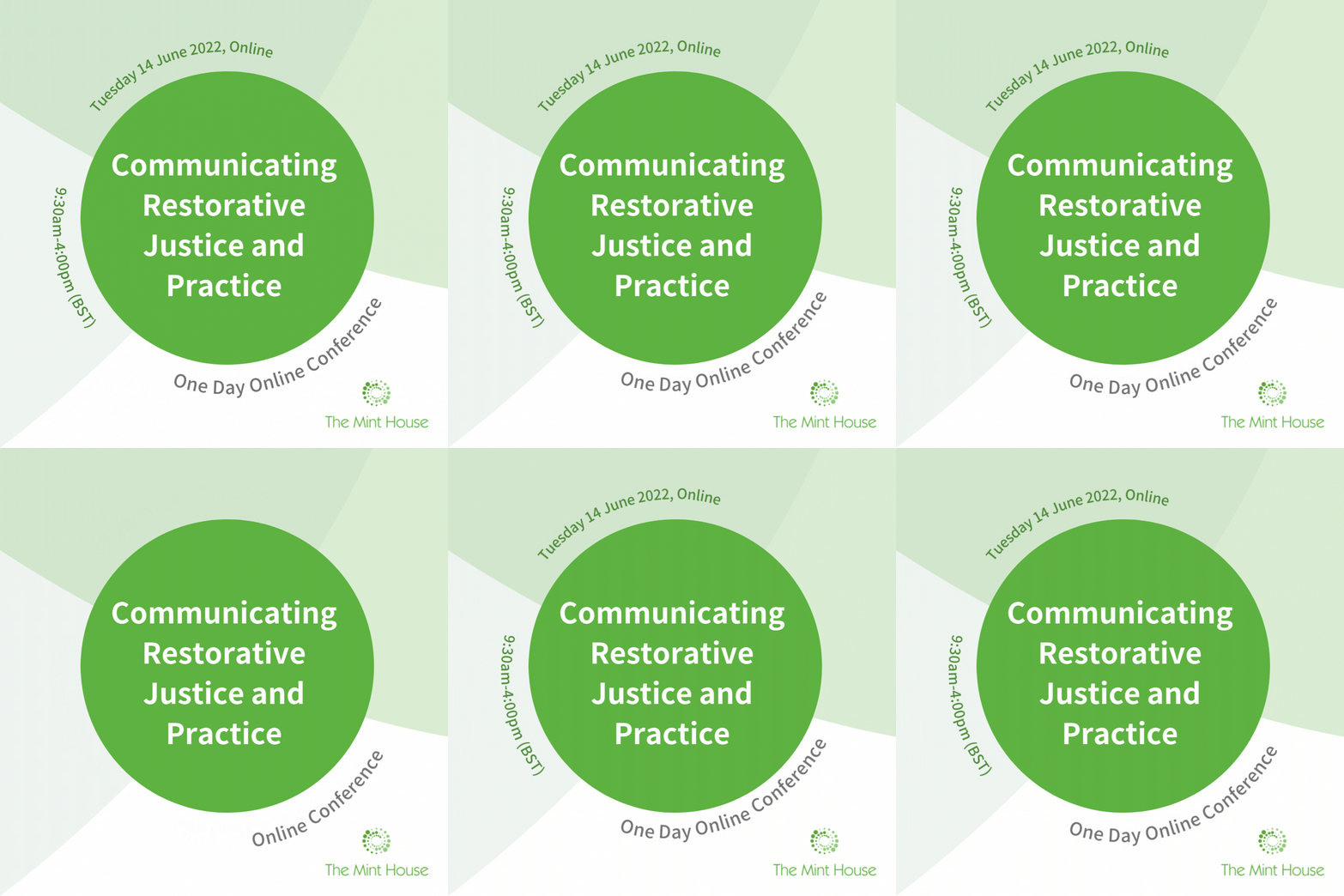
Communicating Restorative Justice and Practice (One Day Conference)
Tuesday 14 June 2022
9:30am - 4:00pm
Online
More information and booking: https://www.minthouseoxford.co.uk/events/2022/6/14/commmunicating-restorative-practice-conference
Restorative Teaching (RJ World Conference 2022)
by Rosie Chadwick
Fabulous session from author and restorative practitioner Leaf Seligman at this week’s RJ World e-conference. Leaf was talking about restorative teaching. Here’s a little of what she shared, illustrated with stories from a writing course she teaches:

Start with yourself – i.e. the importance of inner work and self-care: ‘you can’t offer students what you don’t have as a resource for yourself.’
See your students as co-learners: ‘They’re my teacher as much as I am theirs.’
Remember the 4 verbs:
Notice – be aware of what’s going on for you and for others
Wonder – be curious rather than rushing to judgement
Acknowledge – acknowledge where you make mistakes and acknowledge what’s true for others
Appreciate – both in the sense of showing gratitude but also in the sense of understanding more deeply.
Give co-learners agency – ask learners ‘What do you need to learn? What will be satisfying to you as learners?
Challenge hierarchies of learning: ‘the written word is not always someone’s first language.’
Don’t be afraid of discomfort, whether that’s from making yourself vulnerable or from conversations that you might be tempted to shut down: ‘Discomfort is not the same as danger.’ What’s more, ‘teaching restoratively requires us to be willing to sit in the complicated messy space of being human together.’
It’s OK to take incremental steps. Read the room. Invite humility.
Above all: ‘If relationships are at the centre of our pedagogy then we know we’re on the right track.’
You can find the whole thing here:
RJWorld 2022 Restorative Teaching Video – Leaf Seligman
Happy listening!
Writing "The Meeting Room" - A Stage Play About Restorative Justice
by Rebecca Abrams
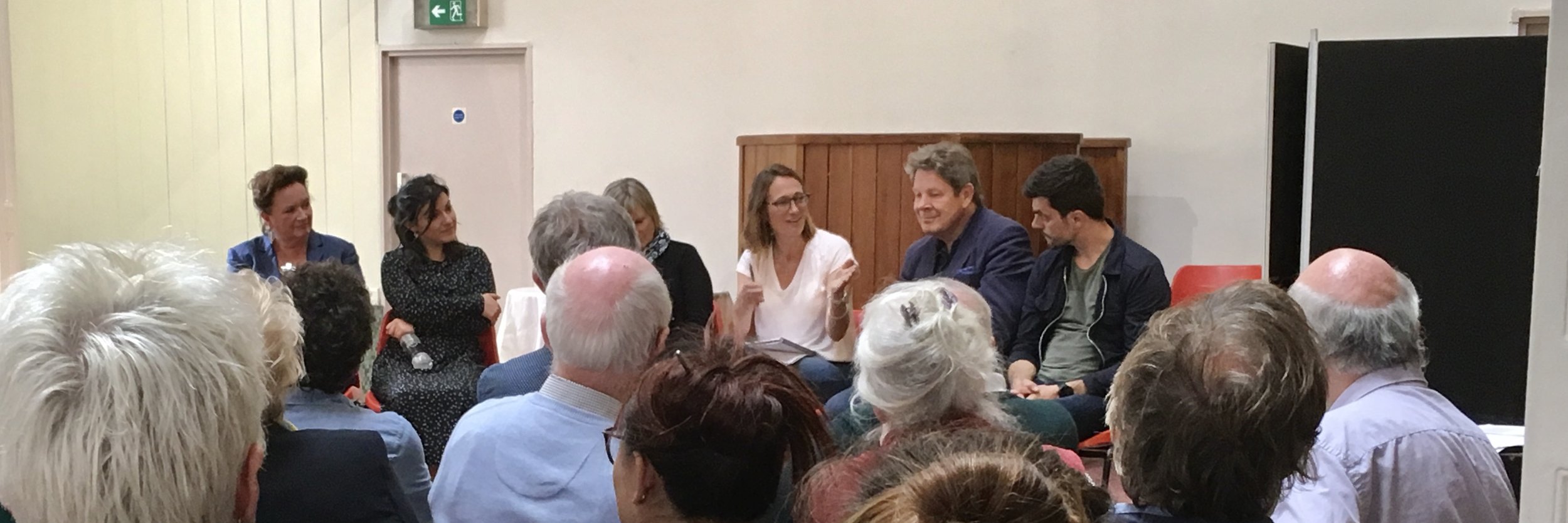
When The Mint House generously offered to host a performance reading of my play The Meeting Room, I said yes without a moment’s hesitation. A few weeks later, on a gorgeous June afternoon in 2019, it was performed in front of an invited audience of about fifty people, with unscheduled musical accompaniment from a busker outside on his electric guitar.
Inspiration for the play came from several sources. As a writer of both fiction and non-fiction, I’ve always been interested in family dynamics and family conflict. The themes of justice and forgiveness have also long fascinated me. And I’d been wanting for some time to write a modern version of the Greek tragedy, Electra, which so powerfully addresses all of these issues.
The idea of writing about the restorative justice process specifically took shape in response to conversations over several years with a close friend about her experiences as a restorative justice facilitator. Her work seemed so vital to me - and so difficult!
How do you loosen the iron grip of anger, pain and grievance? How do you get people to the point where they are willing to sit in a room and talk to the very person who’s hurt them so deeply?

To research The Meeting Room I read about the restorative justice process, and attended a fascinating event at The Mint House with facilitators, victims and ex-offenders. I also visited HMP High Down for the final session of a Sycamore Programme, where I was able to talk to offenders about their experiences. All of these fed into the play in its final form.
The play’s action takes place over nine months, from a first request for an restorative justice meeting to the meeting itself. It centres on a mother and her adult son and daughter. The son has been serving a twelve year prison sentence for killing his father when he was a teenager.
Now due for release, the son wants his mother’s forgiveness. She is torn between a desire to reconcile and a deep fear of reconciliation. The daughter, meanwhile, for reasons of her own, is adamant that there can be no forgiveness for her brother’s actions.
All three characters are locked into conflicting versions of the events that have so powerfully shaped their lives. Some of those events are indisputable, but others sit in the shadows, unacknowledged and terrifying.
During one of our conversations my restorative justice faciliator friend said something that lodged in my mind. ‘The important work has all happened before the victims and perpetrators actually meet,’ she told me, ‘in the weeks and months leading up to an restorative justice meeting.’

Loosening the knots that bind us to a certain way of thinking or feeling, she explained, is a slow and delicate process. One that happens not simply between people, but within them. In physical and temporal spaces, but also in invisible psychological spaces.
In The Meeting Room I wanted to enact all those different kinds of space. To show not only the characters’ physical encounters, but also the internal meetings that take place, in their minds and hearts, consciously and unconsciously. I wanted to explore those shifting spaces between and within them, the spaces where they can, hopefully, begin to encounter other ways of thinking and feeling about the past.

Conflict is at the heart of every compelling story, and every tragic one. The collision of different needs and different ways of seeing the same situation. The RJ process, when it succeeds, does something truly remarkable and infinitely precious. It helps people to move beyond the conflict deadlock.
It enables them to consider events from other perspectives, to meet those they’ve hurt and been hurt by, and also to meet themselves, and encounter different versions of themselves.
Above all, that is what I have tried to explore in this play. Because shutting out the possibility of meeting ourselves and others, with all our mistakes and flaws, our shame and guilt, ultimately makes prisoners of us all.

Rebecca Abrams is an author, literary critic, tutor in creative writing, and journalist based in Oxford.
NOTE (March 2022): We explored this topic further at one of our network events: Using the arts to engage with restorative justice
NOTE (June 2024): The play has been renamed All of Us and we are hosting a film screening of a recording of the play on the 27th of July 2024:

Embedding restorative practice – reflecting on the pieces in the jigsaw and on what we can do together
by Rosie Chadwick
Another year draws to a close, prompting reflection on the journey we’ve travelled and what lies ahead. Looking back, I’m grateful to the many ‘co-travellers’ – event speakers and participants, trainers and trainees, partner organisations and others – with whom it’s been a privilege to work through the year and from whom we’ve taken inspiration, learning and encouragement. As they say at the Oscars - you know who you are: Thank You!!

Looking forward, I’m conscious of the many different elements involved in embedding restorative practice in and across settings and communities. Here are, for me, some key pieces in the jigsaw. It would be great to hear from others what pieces you would add, any you think don’t belong and what your experience has been of fitting them together!

However, I’m also encouraged by the promise of what we can do collectively. On behalf of the Mint House we look forward to a year of creative collaboration with the shared aim of making restorative justice/practice ‘the way we do things round here.’
Applied Theatre and Drama and Restorative Justice
by Miranda Warner

In 2019, in partnership with NGO ‘Restore’ in Pollsmoor Prison, Cape Town, I facilitated a course which utilised an applied theatre toolkit to engage with restorative justice. The course was attended by men who were soon to be released, and focussed on emotional literacy, anger, empathy, forgiveness, and reintegration.
Restorative justice takes the emotional impact of crime on all parties seriously and sees this encounter with the other and their emotional reality as the locus of healing and restoration. My hope was this this emotional, experiential core of restorative justice might interact fruitfully with the practice of applied theatre; as we used drama activities to explore emotions and to embody and investigate the perspective of ‘characters’ other than ourselves.
In our first week we looked at expanding our emotional vocabulary, and we identified the emotions that we were most familiar with, and those which we felt uncomfortable with or unable to share. These themes were explored using drama improvisation activities. The second week focussed on anger and used forum theatre techniques to explore the different ways we can express anger without it leading to violence. The third week centred around the theme of empathy, utilising freeze frames to imagine ourselves as victims of crime. The fourth week explored forgiveness using role play through puppetry. Restorative conversations were acted by puppets and the place and power of apology was explored. The final week centred on the participants’ hopes for life outside prison and the obstacles that might stand in the way of those goals; creating and enacting ‘life obstacle courses’ through which the participants could ‘rehearse’ challenges they anticipated facing on release, building confidence as they did so.
Reflections on the programme from participants saw a high value being placed on the practical, action-based approach, on skills and strategies gained for life on release, and for processing emotions differently. One participant spoke of how his ‘eyes had been opened’ and another said he wanted to return to ‘apologise to each and every person in my street’. A further participant shared the realisation that ‘my actions have an impact on others without [me] even knowing’. Almost all of them spoke of ‘brotherhood’ and community they had found in the group, one writing that in this group he had ‘worked with people “together” which I didn’t’ think was possible’. As an illustration of the potential efficacy of this type of work in restorative practice I shall outline two particularly significant moments from the course in which a meaningful interaction with restorative justice can be clearly identified.
In our third week we staged a still image (like a 3D photograph or a tableau) of a family who returned home from a celebration to discover that their house had been broken into. The actors froze in position reacting to the realisation of what had happened. Each participant was asked to remain in character and describe what they were thinking and feeling. They did this with considerable depth, sometimes breaking into substantial monologues. One character reported that he felt violated by someone having entered his home, another described themselves as terrified and devastated, and a detailed narrative developed concerning the break-in’s impact on one son. In addition, one of the participants watching the scene filled in the house breaker’s story, explaining that he ‘wanted his next fix’ which led to a conversation about the impact of drug addiction upon a community. There was extensive conversation amongst participants about how putting themselves in the metaphorical shoes of those on the receiving end of crime shifted their perceptions. Participants expressed the emotional weight of this expanded perspective and many shared stories of their own experiences at the receiving end of crime.
In our fourth week we co-created a scenario in which a man came home to find his friend in bed with his wife. This man stabbed his friend and later went to prison, whilst the ‘friend’ recuperated. I suggested that two participants could volunteer to enact and explore what might happen when these men met years later if one or both parties were willing to apologise. No-one was willing to step into either of these roles as I was told categorically that ‘men don’t apologise’. The next session we returned to this story we had co-created but this time using the medium of puppetry. Each participant made his own paper puppet and then, in pairs, they carried out a conversation between these puppets. This approach meant that no-one had to act an apology, nor perform one for an audience. Each pair was willing to take part in this version of the activity, and to report their experiences, and a wide variety of different conversations and outcomes were reflected on in the group.
The following week a participant told me that over the weekend his prison gang had required him to assault another member of our group, which he had done. Afterwards, feeling remorse, and reflecting on the conversations we’d had that week, he went to the other participant, apologised, and sought his forgiveness, which was given. They left the session that day with one posing the question; ‘we’re brothers, right?’ and the other giving the response ‘yes, you’ll always be my brother’. This seems to suggest that exploring a fictional restorative conversation from a safe distance created the opportunity to imagine and risk undertaking such a conversation in a non-fictional setting.
The participants’ willingness to engage fully with the course, and the community we forged as they did so, not only had an impact on them, but also challenged, educated, and inspired me in restorative practice. I am richer for the relationships I forged with these courageous and open-hearted men.
Miranda Warner has an MA in Applied Theatre; Drama and the Criminal Justice System and is Restorative Justice Facilitator for Restorative Justice Nelson in New Zealand.
We are exploring this topic further in our upcoming event: Using the arts to engage with restorative justice