
By Paul S. Fiddes

On 2 July 2026 there will be a charity performance of Shakespeare’s play Macbeth in New Road Baptist Church, to benefit (with another charity) the Mint House Centre for Restorative Justice. All of Shakespeare’s comedies and romances, and most of his tragedies, have themes within them that resonate with the practice of restorative justice, but this cannot be said at all clearly of Macbeth. A summary of the plot may well show why. Macbeth and Banquo, generals in the service of King Duncan of Scotland, are returning victorious from battle when they meet three witches gathered in their coven, who present them with predictions relevant to both of them: Macbeth will become Thane of Cawdor and King of Scotland ‘thereafter’, whereas it is Banquo's descendants who will one day be kings. The first prophecy is quickly fulfilled, when Duncan endows the title of Thane of Cawdor on Macbeth. Lady Macbeth then persuades Macbeth to make the second prophecy come true by murdering Duncan while he is an overnight guest at their castle. Macbeth thus becomes King of Scotland, though racked by guilt, and arranges for Banquo to be murdered since he has heard the prophecy and must suspect him of regicide; Macbeth also wants to thwart the prediction that his descendants, not Macbeth’s, will be kings. Macbeth’s mind becomes even more unstable when he alone sees Banquo’s ghost at a banquet. Visiting the witches again, he receives another ambiguous prophecy: they warn him to beware of Macduff, a Scottish noble who, like Duncan’s son, Malcolm, has fled for safety to the English court. However, they assure him that he cannot be harmed by any man ‘born of woman’, and that he can’t be defeated unless the wood of Birnam rises up and moves against him. Macbeth, becoming ever more tyrannical in his rule, orders the murder of Macduff's wife and children.
In England, Malcolm tests Macduff's loyalty to Scotland by confessing to him that he is – supposedly – a man full of defects and vices, lascivious and avaricious, who will only exploit Scotland for his own benefit. When Macduff then shows that he puts his native country above political advantage by withdrawing his support from Malcolm (though, we must say, only after Macduff has stretched his moral principles to breaking point), Malcolm makes clear that he was only testing Macduff and that he will in fact be a king with all the appropriate virtues to govern the country. Together they then raise an army to oppose Macbeth. However Macbeth, relying on the witches’ prophecy, believes that he is invincible against anyone ‘born of woman’, assuming this means everyone. Preparing for battle, he learns that his wife has killed herself, prompting him to despair of any meaning in life, which he now sees as just a series of one day after another: ‘To-morrow, and to-morrow, and to-morrow.’ He sees that the wood of Birnam is indeed rising up, because the invading army has cut it and used the foliage for camouflage. When he meets Macduff in single combat Macduff tells him that he isn’t strictly ‘born of woman’ because he was cut from his mother by Caesarean section. Macbeth nevertheless refuses to surrender and is killed by Macduff. The play ends with Malcolm crowned King of Scotland.
Where, in this sorry tale, is there any hint of restorative justice? Clearly, there is a need for justice to restore a broken situation in the country, but in the play it comes through violence, all stemming from the initial act of murder. In this plot of terrible consequences there seems nothing like a restorative justice moment of listening to the story of the other person, whether offender or victim, and finding a step forward into the future together. We might entertain ourselves by playfully speculating about moments when something like that could have happened. Suppose, right at the beginning, that Macbeth and Lady Macbeth had sat down with friends and discussed their ambitions for power, the temptations offered by the witches, and their grievances against the king: then things might have turned out differently. Suppose, instead of killing Banquo, that Macbeth (feeling a strong sense of guilt as he does) had confessed the murder and listened to the impact he had made on the lives of Malcolm and other friends of the king, although this would have meant accepting punishment, probably death. Suppose, right at the end when called upon to yield by Macduff, that Macbeth had reflected on the suffering he had caused by murdering Macduff’s family and yielded himself up to the punishment of the state. Macduff himself, however, puts this in terms of being subject to public scorn and mockery, not a restorative meeting, and it’s not surprising that Macbeth cries, ‘I will not yield/ To kiss the ground before young Malcolm’s feet,/ And to be baited by the rabble’s curse.’ All these suggestions about restoration conflict with the ongoing momentum of the plot, which is about murder, revenge, and the embrace of death rather than surrender. The overwhelming impression with which we are left is that as far as Macbeth himself is concerned, life ‘is a tale/ Told by an idiot, full of sound and fury,/ Signifying nothing.’ It seems that we can’t make this play ‘signify’ restoration.
Yet there is one point in the play when something happens which comes close to a ‘restorative justice’ moment, in terms of people listening to each other’s story and finding a way forward. At the turning point of the play is the conversation between Malcolm and Macduff, when – despite, or perhaps because of, the deceptive ploy by Malcolm – they try to discover what their true motives are in proposing to take an army against Macbeth. Reaching into each other’s feelings, they discover that neither is driven simply by personal gain, greed, and the desire for personal power. This is a foundation on which to build. Thus, at the end, the audience is encouraged to think that there could be restorative justice with the crowning of Malcolm. He proposes to reward the ‘love of his friends’ and to summon exiles home to help re-make the country, calling these measures to be taken with the help of ‘the grace of Grace’. If only, the audience thinks, he would take time to listen to others as well as to act in making his programme for the future.
Paul S. Fiddes is the author of More Things in Heaven and Earth: Shakespeare, Theology, and the Interplay of Texts (University of Virginia Press).
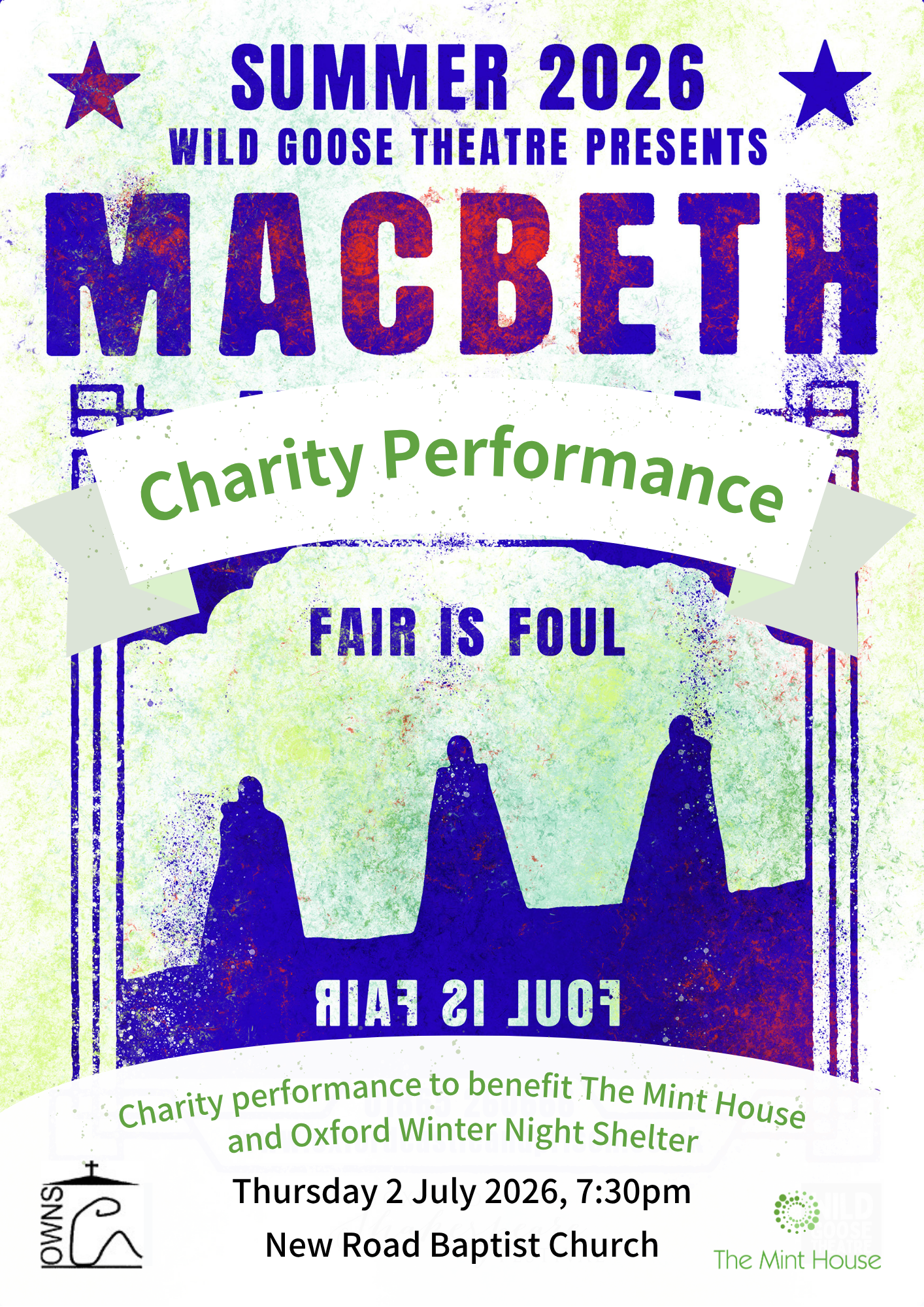
We are delighted that Wild Goose Theatre are putting on a charity preview performance of Macbeth for us next month (Thursday 2 July 2026). More information and a link to buy tickets can be found here: